
Puebla is facing a growing number of complaints related to real estate dispossession and property fraud, placing property owners, land registry authorities, and legal operators under scrutiny.
The state has accumulated hundreds of cases involving dispossession and remains among the states with the highest incidence in the country. At the same time, reforms promoted by the state government and local Congress acknowledge that these practices may involve forged documents, simulation of legal acts, and the possible participation of public officials or legal notaries.
The situation bears similarities to some of the practices investigated in Mexico City under the so-called real estate cartel. However, the official data currently available, reviewed by Quadratín Puebla, do not allow it to be stated that a criminal structure with the same characteristics currently operates in Puebla, nor that there is a network of judges, magistrates, notaries, and officials acting in collusion.
Puebla, Among the States with the Most Cases of Dispossession
Figures from the Executive Secretariat of the National Public Security System (SESNSP) show the scale of the problem. During the first half of 2026, Puebla accumulated 830 records for the crime of dispossession, placing the state in fourth place nationwide.

The figures are particularly relevant considering that dispossession directly affects victims’ property and may involve homes, land, commercial premises, and plots whose ownership or possession becomes disputed. During the first two months of the year, the state had recorded 245 investigation files for this crime, compared with 216 during the same period in 2025.
Puebla City had the highest number of cases, followed by municipalities such as Amozoc, Tehuacán, Atlixco, Huauchinango, Coronango, Huejotzingo, and San Pedro Cholula.
The State Government Acknowledges the Risk
In February 2026, the Government of Puebla presented an initiative to increase penalties for real estate dispossession. The proposal establishes harsher sanctions when the crime is committed through forged documents, simulated acts, or mechanisms intended to make an operation appear legal.
It also establishes aggravating circumstances when notaries, public brokers, or public officials participate in facilitating or concealing the dispossession. The proposal is significant because it recognizes that the crime may go beyond the physical occupation of a property: a property can be taken through violence, but also through a documentary operation intended to turn an illegal occupant into a legitimate owner.
This is where one of the similarities with the phenomenon investigated in Mexico City emerges.
Documents, Notaries, and Registries: The Area of Greatest Risk
Organized real estate dispossession may, in some cases, require more than people entering a property. It can involve deeds, notarized powers of attorney, contracts, identification documents, registries, and judicial or administrative procedures.
For this reason, Puebla’s legislation incorporated the use of forged documents and simulated procedures as a risk scenario. An initiative presented before Congress also proposed penalizing collusion with notaries, public brokers, public officials, and individuals involved in government functions.
The legislative proposal does not prove that a criminal network exists, but it does show that local authorities identified the possibility that dispossession could be committed through an institutionalized structure designed to give it the appearance of legality.
A Precedent Within the Public Property Registry
The hypothesis regarding possible corruption risks in areas related to property is not foreign to Puebla either. In July 2025, the State Attorney General’s Office (FGE) reported that a former Public Property Registrar of Teziutlán had been bound over for trial on charges of bribery.
According to the Prosecutor’s Office, the former official allegedly attempted to provide 50,000 pesos to prevent administrative reviews at the registry office under his responsibility. Although the case does not publicly link him to a real estate dispossession network, it establishes a precedent: an institution responsible for providing legal certainty regarding property ownership may be exposed to acts of corruption.
The Prosecutor’s Office Has Already Restored Properties
FGE case files show that dispossession is not merely a civil dispute. In January 2026, the agency reported the restitution of a property used as a warehouse at the Regional Supply Center “Benito Juárez,” in San Salvador Huixcolotla.
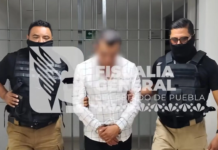
Another case occurred in the Popular Coatepec neighborhood in Puebla City, where a man was arrested in connection with a dispossession that had occurred since 2019, when he allegedly entered the property with 130 people. In San Miguel Xoxtla, the Prosecutor’s Office also arrested an individual for occupying a plot of land together with approximately 30 people.
Fraud: Another Component of the Problem
The 2025 National Survey of Urban Public Security Victimization and Perception (ENVIPE) conducted by INEGI estimated that 35.4% of households in Puebla were victims of at least one crime during 2024. SESNSP records also show an increase in fraud cases in Puebla: between January and May 2026, 2,565 investigations were recorded, an increase of 33% compared with 2025.
What Happened in Mexico City?
Investigations conducted in Mexico City focused primarily on the Benito Juárez borough and pointed to an alleged structure in which officials and private individuals may have participated in irregular real estate operations.
The capital’s case is relevant to Puebla because it shows how an apparently administrative activity can become a source of illicit enrichment when there is coordination between private individuals and public officials. In Puebla, the official information currently available does not establish an equivalent organization at this time.

Source: puebla.quadratin