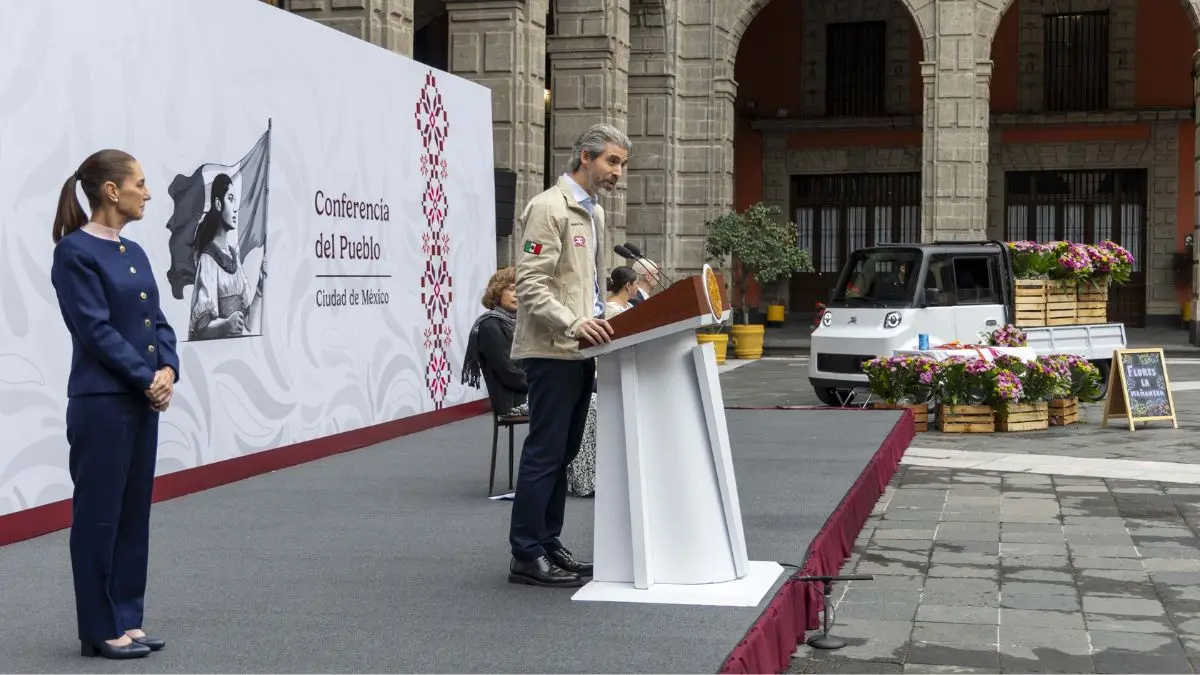

Roberto Capuano Tripp, director of Olinia, announced that the Olinia project aims to reach an annual production of 50,000 units. In the first year, production will begin with 10,000 electric vehicles, of which 8,000 have already been reserved by Puebla, the State of Mexico, and Mexico City.
During the Mañanera del Pueblo, after presenting the Olinia 2 cargo vehicle, he emphasized that the goal is for the car to go on sale in the summer of 2027. This follows the call for companies interested in participating in its manufacturing.
The director emphasized that Puebla is the state most interested in acquiring Olinia units and even serves as the project’s operational center.
Recently, Governor Alejandro Armenta Mier announced that 3,000 units of this vehicle will be purchased in 2027. Subsequently, the state will provide a 20 percent down-payment contribution for another 5,000 vehicles in order to transition away from conventional transportation.

Progress of the Olinia Project
A charging-network infrastructure program is currently being implemented in these three states so that the vehicles have the necessary facilities for their operation.
This is due to their membership in the Commission for Environmental Cooperation of the Megalopolis (CAME) and their proximity to the project’s center and the federal government. The deployment is not limited to the installation of charging points but also includes projects to replace taxi and motorized tricycle fleets, taking advantage of the existing infrastructure provided through the Federal Electricity Commission (CFE).
Roberto Capuano emphasized that the Olinia project includes the domestic manufacturing of critical components, particularly batteries. These account for approximately 40 percent of the vehicle’s cost.
For this reason, he said the project seeks to establish partnerships with the private sector to accelerate the production, distribution, and financing of the vehicle, while taking advantage of the industrial capabilities already available in the country.
The business model is based on a mixed public-private investment scheme to ensure financial sustainability and continuous innovation, avoiding permanent dependence on public resources.
Source: angluo7