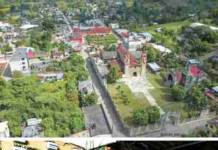
The Puebla government will acquire up to 1,319,605 forest and fruit trees, which will be used to reforest 10 degraded areas affected by forest fires in the state between August and November.
To this end, it launched the national public tender GEP-SPFA-LPN-181-527/2025, for the contracting of the service, which includes the acquisition, management, and distribution of the trees, which will be carried out in 10 regions of the state.
It is worth noting that on June 5, Governor Alejandro Armenta Mier launched the 2025 reforestation campaign. This campaign will involve the planting of 1.7 million trees from June to October throughout the state.
He stated that this action is part of a plan to transform Puebla into a forested, sustainable area free of environmental corruption. Therefore, during his six-year term, 12 million plants will be planted on 12,000 hectares.

Through the tender issued by the Ministry of Environment, Sustainable Development, and Territorial Planning (SMADSOT), 1,319,605 forest and fruit trees will be purchased. As previously mentioned, they will be used in deforested, degraded, and forest fire-affected areas.
They will reforest areas affected by fires.
It is emphasized that the service must be provided from the formalization of the contract until November 30, 2025. It should be noted that the supplier will be responsible for the distribution and delivery of all the plants.
According to the document, there will be 342,062 white pines, 300,000 sad pines, 200,000 pine trees, 100,000 sabinos, and 60,000 Christmas pines. As well as 40,000 mahogany plants, 40,000 allspice plants, 35,000 pulquero maguey plants, 30,000 chamalite pine plants, and 29,605 tobalá maguey plants.
In addition to 20,000 espadín maguey plants, 20,000 stone pine plants, 20,000 highland pine plants, and 20,000 mesquite plants, there are also 17,646 Persian lime plants, 17,646 fig plants, 17,646 walnut plants, and 10,000 guaje plants.
What are the 10 deforested regions of Puebla?
These species will be distributed in the regions of Tehuacán, Izúcar de Matamoros, Santa Rita Tlahuapan, Acajete, and Ciudad Serdán. As well as San Salvador El Seco, Chignahuapan, Chignautla, Oriental, and Vicente Guerrero, the delivery must be between August 29 and September 29.
The tender specifies that, for the delivery of the plant, the supplier must coordinate with the Directorate of Natural Resources and Biodiversity Management.
Transportation must be carried out with the utmost care to avoid damage to the stem or root; therefore, container-grown plants must be prepared in advance.
For bare-root plants, they must be delivered in sackcloth in groups of 500. Fruit trees must be delivered in the correct form.
The clarification meeting will be on August 18, the presentation of technical proposals on the 22nd, and the financial proposals on the 26th. The decision is scheduled for the 28th of this month, as distribution of the plants is scheduled to begin at the end of the month.

Source: angulo7